The STORI Scorecard: Balancing AI for Sustainable Impact

TL;DR
AI success hinges on more than models and data; organizations need a balanced scorecard to drive real value.
The STORI Scorecard measures five interdependent dimensions: Strategy, Technology, Organization, Responsibility, and Innovation.
Too often, companies chase deployment velocity at the expense of ethics, culture, or long-term ROI.
A holistic framework ensures executive accountability, cross-functional alignment, and ethical guardrails.
Quarterly dashboards based on STORI reveal hidden gaps and guide investment decisions.
Embedding STORI into board reports transforms AI from a siloed initiative into a balanced management system.
This is the sixth and final steps in our Play to Win for AI strategy series. Over the past five newsletters, we’ve walked through the five stages of Play to Win applied to AI: setting a Winning Aspiration, choosing where to play, defining how to win, building the right capabilities, and embedding management systems. Together, these steps form a solid foundation. But without measurement, even the sharpest strategy drifts.
Why AI Needs a Scorecard
When AI leaders chase rapid deployment, they often sideline the human, ethical, and strategic dimensions that determine whether an initiative truly creates value. Too many organizations celebrate the day a model goes live, only to wonder later why revenue lifts plateau or why customer trust erodes.
A balanced scorecard reframes the question. It moves us from asking, “Can we build it?” to “Should we build it, and can we sustain it?”
In my work, I’ve seen pilots stall not because the algorithms failed, but because governance was absent and organizational buy-in lagged. The underlying problem is that technology deployment outpaces organizational readiness and ethical oversight. Leaders often say: “We invested millions in ML, but forgot to invest in people and processes.”
That’s where the STORI Scorecard comes in.
The STORI Scorecard: Five Interdependent Dimensions
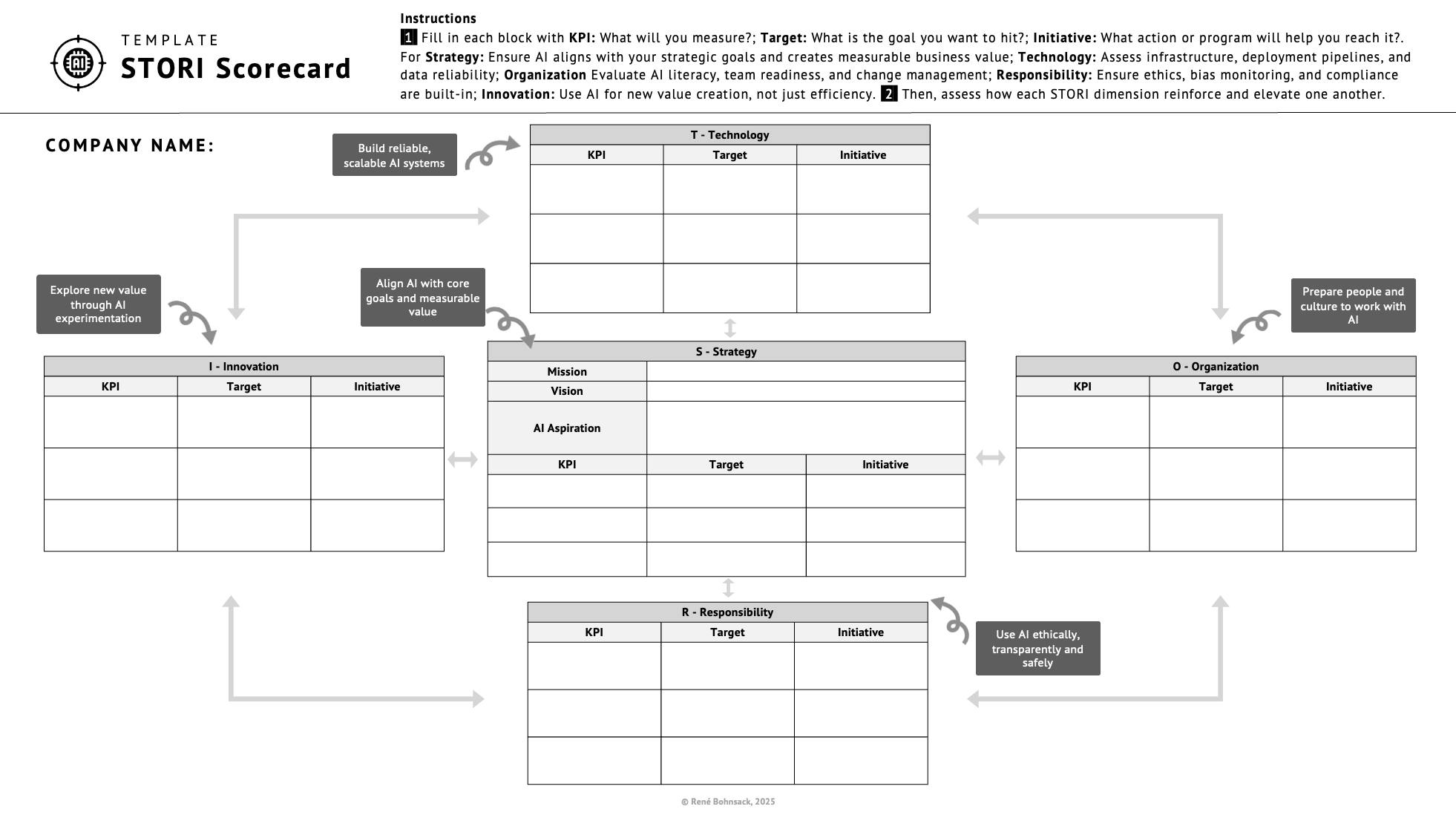
The STORI Scorecard is a strategic performance framework designed for the AI era. It helps leaders measure, manage, and evolve AI capabilities across five interconnected pillars.
1. Strategy: Is AI delivering real business value?
AI initiatives succeed when they serve a clear purpose. The question is not “What can the model do?” but “What outcome does it achieve?”
Key indicators:
% of revenue uplift from AI-enabled products
Success rate of AI initiatives against strategic targets
Alignment with customer and operational priorities
Example: A streaming platform using AI-driven recommendations to personalize content directly links its algorithmic output to retention and revenue.
2. Technology: Are your systems robust and scalable?
Strategy sets the destination. Technology builds the road. Without a resilient infrastructure, even the smartest model will buckle at scale.
Key indicators:
Deployment velocity (prototype → production)
Reliability and uptime of data pipelines
Efficiency of retraining and monitoring cycles
Example: A global e-commerce player continuously tracks ML-pipeline efficiency, enabling rapid iteration and reliable launches across multiple business lines.
3. Organization: Are people and culture ready?
AI creates value only when people use it. This pillar gauges readiness through literacy, upskilling, cross-functional collaboration, and change-management maturity.
Key indicators:
% of employees completing AI training
Presence of cross-functional AI squads
Adoption of redesigned workflows
Example: A large enterprise rolling out AI fluency programs across finance, marketing, and operations ensures every function speaks the same “AI language,” reducing friction and unlocking collaboration.
4. Responsibility: Are you building trust?
Ethics, compliance, and governance aren’t optional. They’re foundational. Responsibility ensures that adoption doesn’t outpace trust, reputation, or regulation.
Key indicators:
% of projects reviewed for ethics and compliance
Incident rates (bias, privacy, misuse)
Existence and activity of an AI Ethics Board
Example: A multinational requiring every high-impact project to pass governance checks before deployment safeguards both innovation and reputation.
5. Innovation: Are you creating new value?
Efficiency matters, but AI’s true potential lies in discovering new frontiers. Innovation ensures experimentation isn’t a side project but a strategic engine.
Key indicators:
Number of AI experiments and pilots
Time from concept to prototype
Share of innovation budget allocated to AI initiatives
Example: Dedicated research labs generate breakthroughs that feed back into core businesses, showing how blue-sky research drives tangible outcomes.
Why the Connections Matter
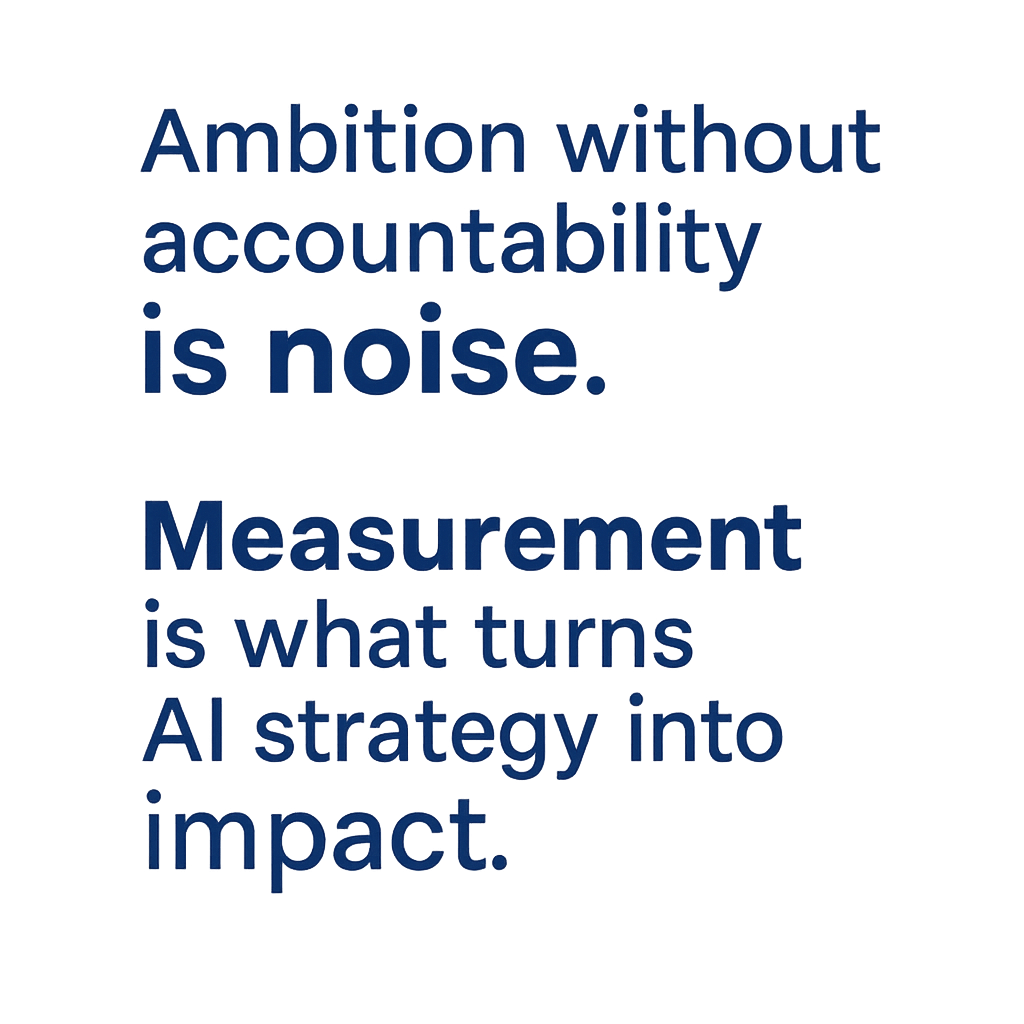
Each pillar delivers value on its own, but their true power lies in how they reinforce one another.
Strategy + Technology: Clear goals sharpen technical roadmaps; strong platforms reveal new strategic horizons.
Technology + Organization: Reliable pipelines empower non-tech teams to engage, feeding insights back into the models.
Organization + Responsibility: Ethics training embedded in upskilling programs creates shared vigilance and safe spaces to experiment.
Responsibility + Innovation: Strong guardrails speed approvals and build trust, letting pilots scale faster.
Innovation + Strategy: Rapid experiments spark new opportunities, while strategy ensures resources flow to what matters most.
Think of STORI as an ecosystem: each element sustains and elevates the others.
Bringing STORI to Life in Your Organization
How do you make this practical?
Baseline Assessment
Start with diagnostics across all five dimensions. Use a mix of KPIs and qualitative inputs to get a maturity snapshot.Integrate with Strategy
Embed STORI into board and executive reporting. Use dashboards (RAG or spider charts) to visualize gaps and dependencies.Assign Accountability
Make each pillar someone’s responsibility: CTO for Technology, CHRO for Organization, CRO/GC for Responsibility, CINO for Innovation, CEO/CAIO for Strategy.Track Quarterly
Review metrics, lessons learned, and adjust targets every quarter. Don’t just report—use the findings to reallocate resources and refine governance.Celebrate Integrated Wins
Highlight stories where collaboration across dimensions created breakthrough value. Make balance visible.
The Leadership Tool for AI
The STORI Scorecard is not a technology tool. It’s a leadership tool. It ensures that AI investments are not only technically sound but strategically aligned, organizationally supported, ethically grounded, and innovation-driven.
It balances the rush to deploy with the need to sustain trust, culture, and impact.
The STORI scorecard is not a checklist but a living system that integrates outcomes, enablers, and safeguards.
Where Does Your Organization Stand?
AI isn’t just about algorithms. It’s about orchestrating people, processes, and principles toward shared outcomes. The most transformative initiatives align strategic intent with cultural readiness, technological rigor, ethical guardrails, and a spirit of experimentation.
So, how balanced is your AI scorecard today? And where should you focus next to ensure AI becomes a sustainable engine of value?
👉 Download the STORI canvas to start building your own balanced AI management system.