
Building the Muscles to Compete - What Capabilities Must Be in Place?

TL;DR
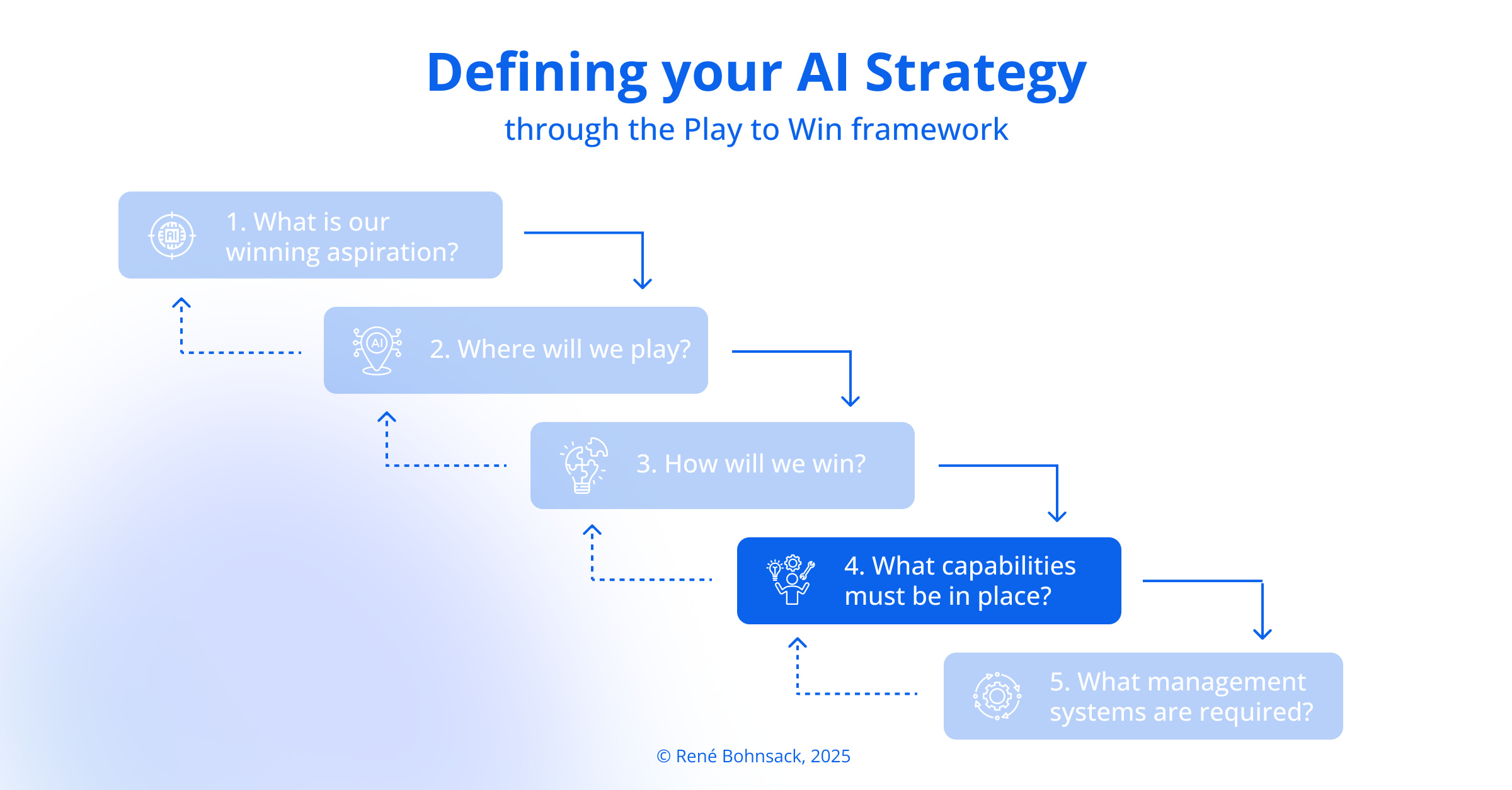
The fourth stage of Play to Win - What capabilities must be in place? - is where strategy turns into execution.
AI success is rarely limited by ideas. It fails when organizations don’t have the data, infrastructure, skills, or culture to scale.
Prototyping is a powerful way to test ambition against reality, exposing capability gaps early.
Leaders must be clear about which muscles they need to build, whether to build, buy, or partner, and in what sequence.
Case studies from Drydocks World show that progress depends less on pilots, more on the scaffolding that supports them.
From Vision to Muscle
In the last three newsletters, we moved through the first stages of Play to Win: defining a Winning Aspiration, making tough calls on Where to Play, and deciding How to Win by turning ideas into advantage.
But the hard truth is this: even the sharpest strategy won’t survive contact with reality unless the right capabilities are in place. AI is unforgiving that way. You can design the best roadmap on paper, but if you don’t have clean data, enough skilled talent, strong governance, or the infrastructure to scale, the projects will stall.
MIT’s 2025 State of AI in Business report reinforced this point: most GenAI projects don’t fail because the model doesn’t work. They fail because organizations can’t integrate them into workflows, train staff to adopt them, or stitch together the data foundations needed to scale. Capabilities, not ambition, are what make or break AI strategy.
Why Capabilities Matter
Capabilities are the hidden muscles of transformation. They’re not flashy like a new chatbot or predictive model, but they determine whether AI sticks and grows. This includes the obvious - data infrastructure, platforms, talent - but also the softer elements: governance, change management, and culture.
In our programs, we often see that the greatest breakthroughs come not from building a new model but from getting the fundamentals right. When leaders realize their ERP data is messy, or their teams don’t yet trust AI-driven decisions, they begin to see why strategy must be backed by muscle.
The Role of Prototyping
One of the best ways to surface capability gaps early is through rapid prototyping. Rather than debating endlessly whether your organization is ready, you put an AI use case into motion, even as a lightweight MVP.
Prototyping does three things:
Tests ambition against reality. A prototype reveals whether the data exists, the workflows integrate, and the talent is in place.
Exposes hidden blockers. Issues like data gaps, governance needs, or change resistance surface early, before major resources are committed.
Creates momentum. A working MVP, even if rough, turns abstract strategy into something tangible that teams can rally around.
That’s why in this stage of Play to Win, we encourage leaders to not just theorize about capabilities but to prototype their way into clarity.
Case in Point: Drydocks World
Take Drydocks World, one of the world’s leading shipyard operators. Their ambition is bold: to become the world’s leading “smart shipyard.” They identified high-impact AI opportunities like predictive maintenance, intelligent scheduling, and digital twins. But when they mapped these ideas against capabilities, the gaps became obvious. So instead of rushing forward on every front, they made disciplined choices.
This capability-first approach turned an overwhelming wish list into a staged, realistic plan. Drydocks realized that success wasn’t just about “what projects to do,” but about what muscles they needed to build to make them possible.
The lesson is clear: capabilities aren’t a supporting act. They are the main stage on which AI strategy succeeds or fails.
Try This: A Capability-Building Exercise
Here’s a simple three-step exercise we use in our programs to connect strategy to capabilities:
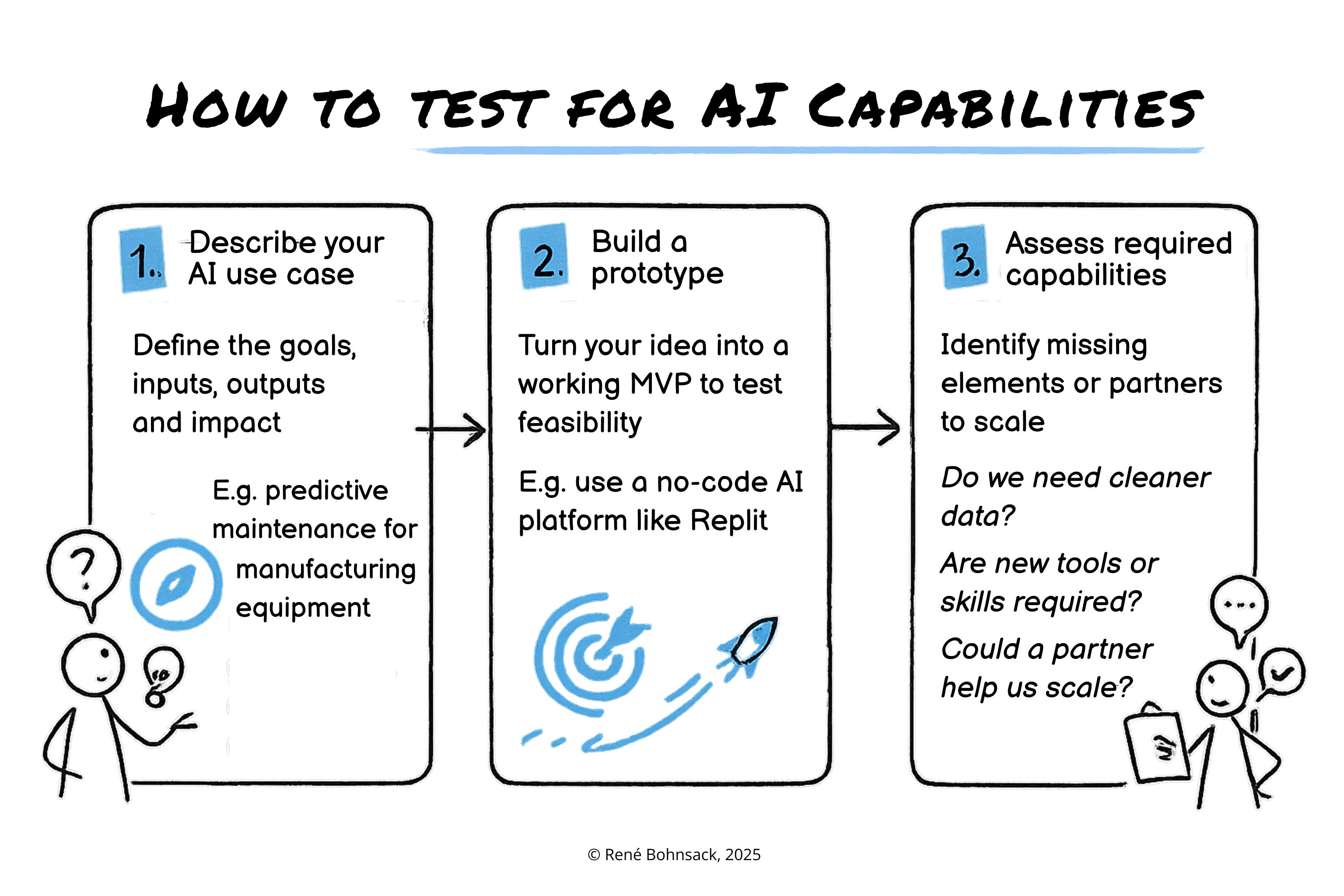
Describe your AI use case
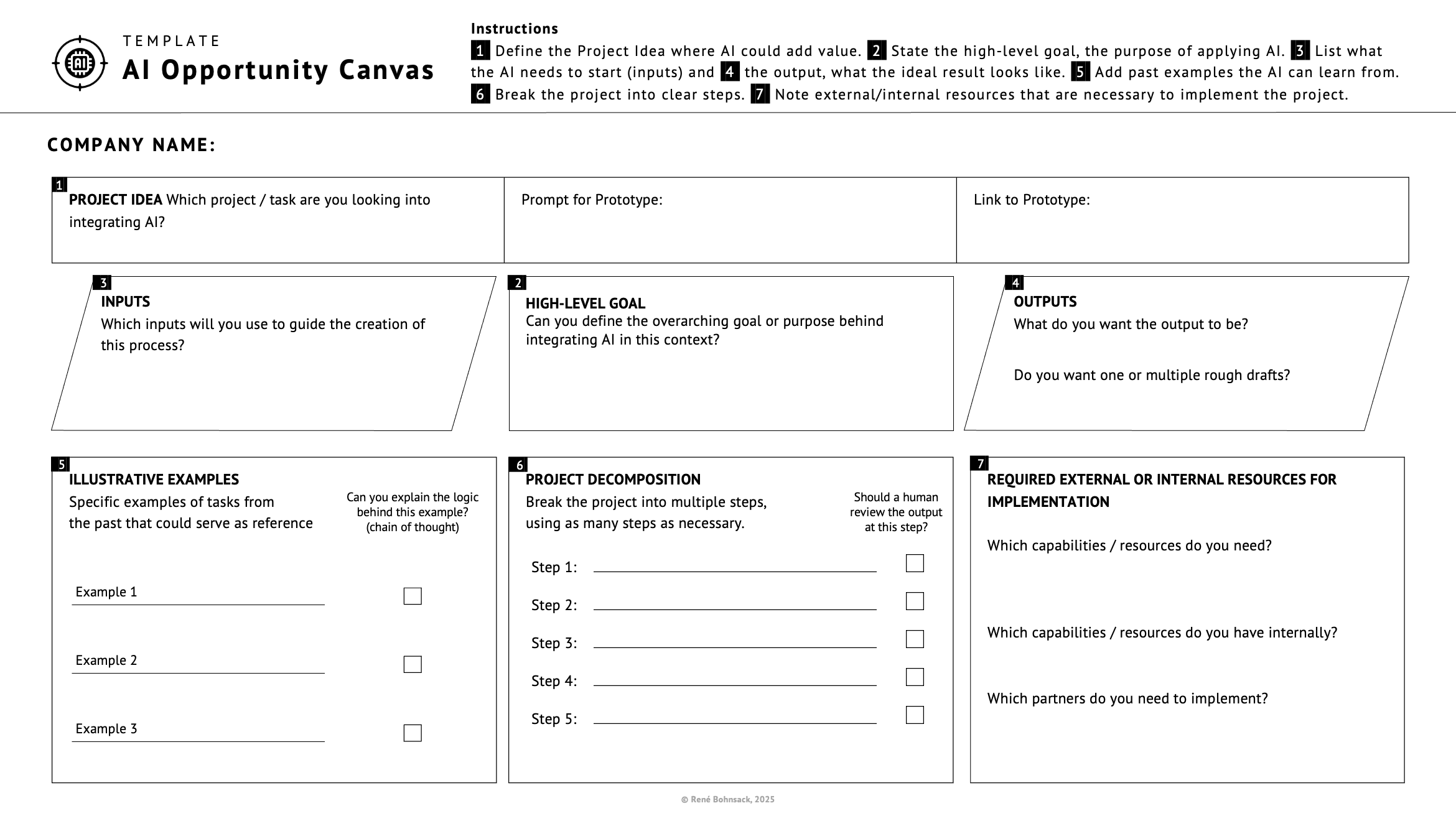
Use an AI Opportunity Canvas to define the goal, inputs, outputs, and impact of your idea. Write down why it matters, what success looks like, and what data or context is required.Build a prototype
Turn your idea into a working MVP using a no-code AI platform. Write a “power prompt” to instruct the tool (e.g., v0, Replit, Lovable). The goal isn’t to perfect the solution but to test whether the foundations - data, integration, usability - exist to make it real.Assess required capabilities
Once you have a prototype, ask: what’s missing to scale this solution? Do we need cleaner data, new skills, different tools, or strategic partners? Write down the critical gaps and decide whether to build, buy, or partner to fill them.
This exercise keeps the conversation grounded. It prevents strategy from floating in the abstract and forces the team to confront what’s possible now, and what still needs to be developed.
Building Capabilities: A Pragmatic Approach
Capabilities aren’t built overnight. The most successful organizations start with three simple steps:
Identify the essentials. Tie capabilities directly to your aspiration and “how to win” choices. For example, if you want to compete on customer intimacy, personalization engines matter more than robotics.)
Map the gaps. Be honest about what’s missing: is it data quality, infrastructure, or cultural readiness?
Choose the path. For each gap, decide whether to build internally, buy talent or tools, or partner strategically.
Different organizations have different muscles but the same principle: strategy succeeds at the speed of capability-building.
Closing Reflection
Capabilities are the bridge from aspiration to execution. Without them, AI strategies remain visions on a slide. With them, pilots become platforms, and ambition turns into measurable business value.
As you look at your own AI roadmap, ask yourself:
What are the must-have capabilities to support our chosen strategy?
Where are the gaps?
And are we willing to build, buy, or partner to fill them?
In the next and final part of this series, we’ll turn to the fifth Play to Win question: What management systems are required? We’ll explore how to embed AI strategy into the governance, incentives, and culture of your organization so it sustains long after the pilots (read here).
Until then: Which capabilities must your organization strengthen today to compete tomorrow?